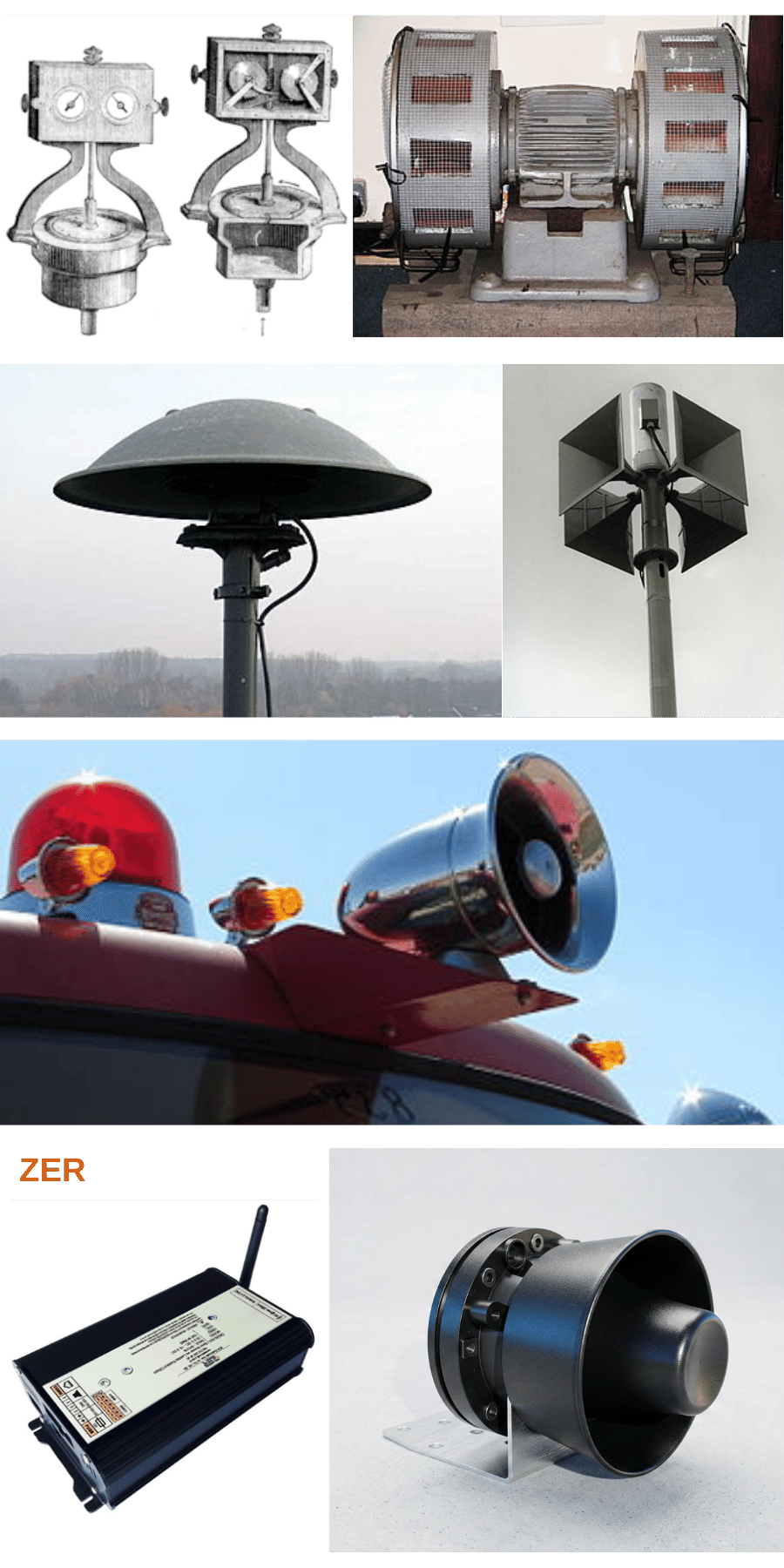
Siren systems are among the most important acoustic technologies developed in human history for warning and alarm purposes. The first mechanical siren was described by John Robison in 1799, and the foundations of modern siren technology were established in 1819 by Charles Cagniard de la Tour.
Early sirens operated entirely on mechanical principles. Intermittent sound waves were generated through rotating perforated discs and directed airflow, producing a single-frequency yet highly attention-grabbing alarm sound. These systems were widely used in factory warning systems, fire alarms, and civil defense sirens deployed throughout cities.
Over time, with increasing urbanization and the growing importance of emergency management, siren technology underwent a significant transformation. Especially from the mid-20th century onward, more powerful siren solutions capable of being heard over longer distances were developed for defense systems, air raid warnings, fire engines, and ambulances.
During this period, pneumatic and electromechanical systems came to the forefront. Air-pressure-driven sirens reached higher sound levels, while directional horn structures enabled sound to be transmitted more effectively to specific areas.
In the modern era, siren technology has evolved entirely into electronic and digital systems. Today’s sirens are capable of producing different tones through digital signal processing (DSP)-based structures and can be optimized according to specific operational conditions.
The modern siren tones commonly used in emergency vehicles include:
- Wail: Provides long-distance detectability
- Yelp: Draws attention in dense urban traffic
- Hi-Lo: A dual-tone warning sound widely used in ambulance applications
This multi-tone structure has been developed to ensure maximum recognizability under different environmental conditions.
Why Do Siren Sounds Attract Attention?
The main reason siren sounds are so effective is that they directly trigger the human brain’s attention mechanism.
Constant-frequency sounds can gradually be filtered out by the brain as background noise. However, continuously changing frequencies keep the brain’s alert and orientation mechanisms active. For this reason, frequency modulation is of critical importance in siren design.
Another important factor is the Doppler effect. The sound emitted by a moving vehicle siren is perceived at a higher frequency as the vehicle approaches and at a lower frequency as it moves away. This change helps drivers quickly understand the direction of the sound and the speed at which the vehicle is approaching.
In addition, sirens are designed to operate at high decibel levels. This ensures audibility even in heavy traffic, urban noise, or enclosed environments.
In the development of siren technology, not only sound intensity but also sound directionality and perception time play a critical role. In modern systems, speaker geometry, horn structure, and frequency distribution are optimized to ensure rapid detection, especially under dense traffic and high environmental noise conditions.
Acoustic engineering studies focus on determining the frequency ranges to which the human ear responds most rapidly. As a result, sirens become not only an audible warning but also a safety signal whose direction and approach can be easily perceived.
Today’s Technology
The most advanced stage of this historical development can be seen in the next-generation siren systems developed by our company. Thanks to modern electronic infrastructure, high acoustic performance, multi-tone support, and reliable control systems, maximum recognizability and operational safety are ensured in emergency vehicles.
The most advanced reflection of this historical evolution today comes to life in the next-generation siren systems developed by ZER Elektronik.

.png)
.png)